CX research · April 2026
Signal After Ship
A repeatable program that turns thousands of app reviews into specific, undeniable customer problems a product team can act on
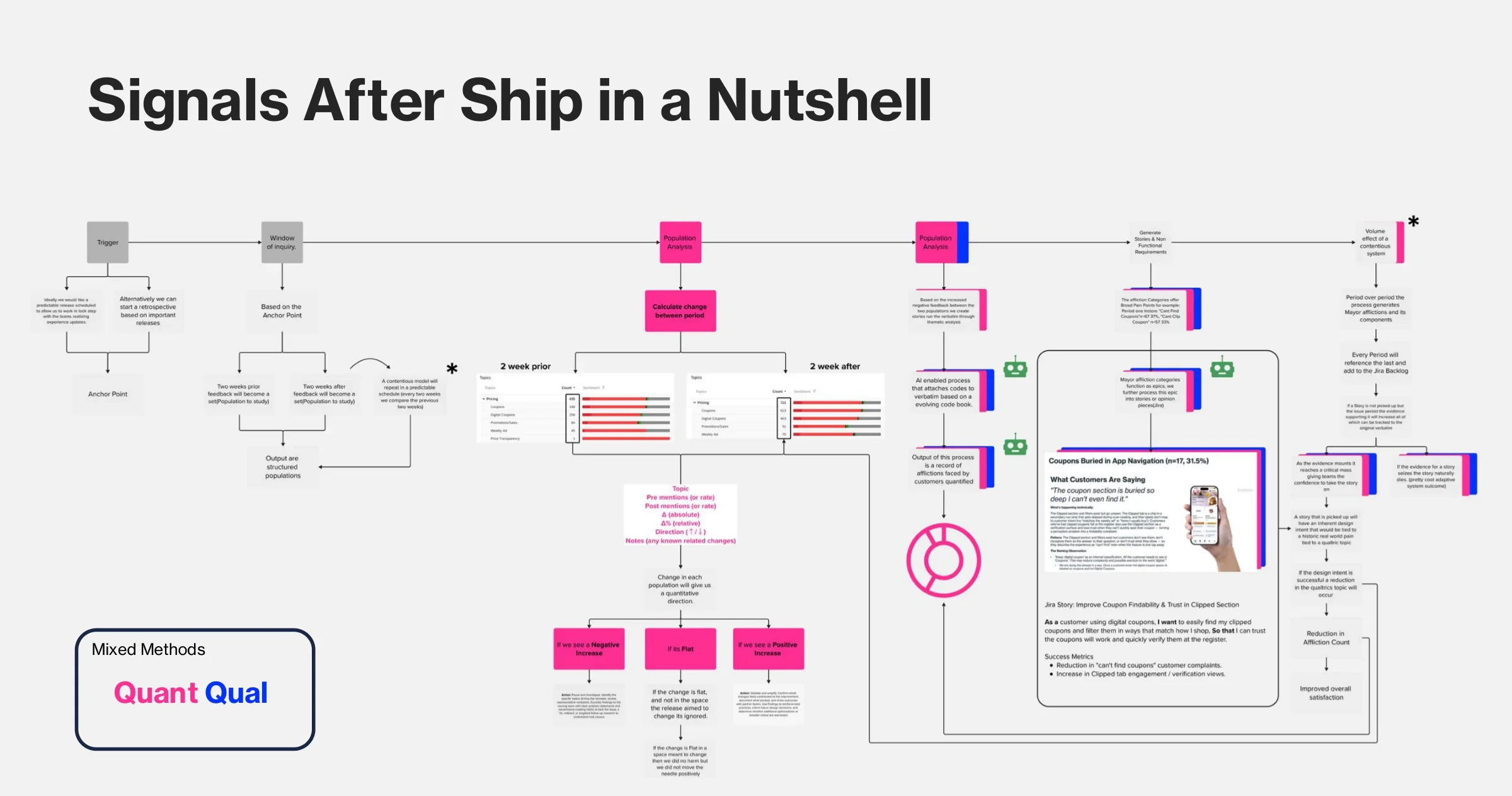
- pieces of feedback narrowed to the most negative iOS verbatims
- 24k → 546
- in-store coupon verbatims coded by failure point
- 270
- overall growth in feedback volume, used as the baseline
- 10.8%
- of in-store coupon complaints: customers cannot find coupons
- 33.3%
The opportunity: Kroger collects an enormous amount of customer feedback, but headlines like "Price & Savings Clarity is a problem" are easy to nod at and easy to deprioritize. Signal After Ship takes the highest-volume complaints, unpacks exactly how they show up in real customer experiences, and delivers them in a form that leadership can prioritize and teams can act on immediately.
Where it started
In late March 2026 our team was asked to add color to a directional insight: shoppers can't confidently plan budgets or baskets before a trip. The natural next question was show me the data.
The first cut was still black and white. The in-store planning pain points were ranked by share of all negative feedback, with "Price & savings clarity during planning" at 34.5%. It told us what was wrong, but not what a shopper actually ran into.
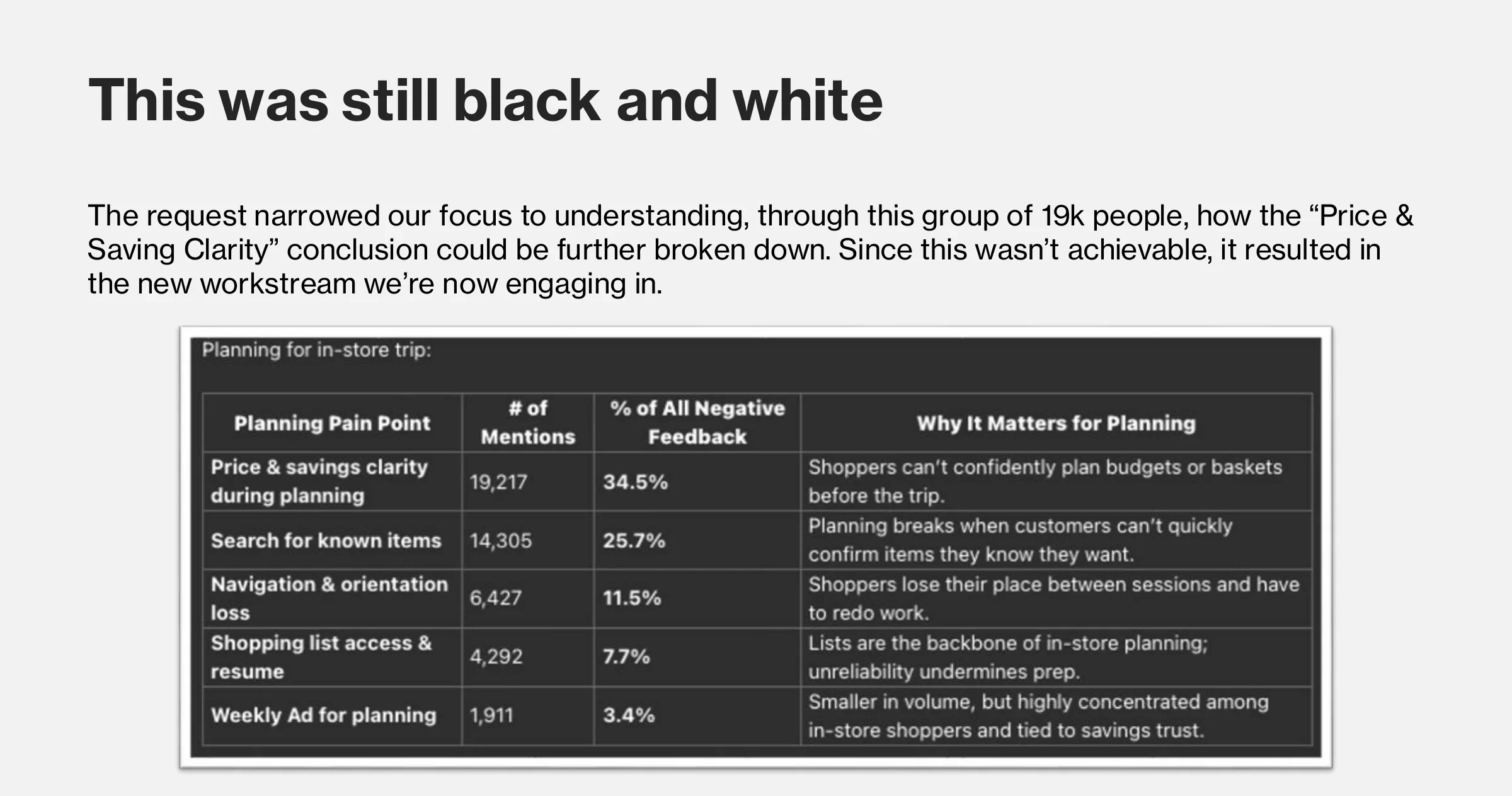
A ranked list of themes. Useful for sizing the problem, not enough to fix it.
The mission
We set the mission as a mixed-methods one: a quantitative signal triggers the work, and qualitative depth explains it. The program was guided by a set of principles:
- Provide color, context, and real-life examples, not just headlines. When customers say something is hard, show every way it breaks
- Prescribe outcomes, not solutions. Write each problem like a Jira story, "As a Kroger shopper, I need to feel confident that my coupon has been clipped", and leave the how to the team
- Let quant be the trigger, not opinion. The volume of mentions starts the work, and the research goes deep on the why
- Start with one theme and push it all the way through, then document it as a formula that is repeatable for every theme after
- Bridge the gap between data and action. Teams had historically fixed the problems that were easy to fix instead of the ones that moved the needle for customers